Telegram Bot Revenue Models: A Strategic Guide

- bot monetization
- telegram stars
- telegram bot revenue
- saas
- fintech
- telegram business
In the rapidly evolving digital economy, Telegram has grown beyond a simple messaging application into a solid commercial ecosystem. For developers, entrepreneurs, and business operators, understanding the array of Telegram bot revenue models is critical. It marks the transition from building a hobby project to establishing a sustainable, scalable business. With a user base approaching one billion and a uniquely flexible API, the platform offers a fertile ground for monetization where user friction is minimal and the potential for commercial success is significant. We at TeleSuite have seen firsthand how operators who strategically align their monetization with their bot’s core value proposition can achieve remarkable growth. This guide offers a framework for that process.
Short answer
Effective Telegram bot monetization involves selecting a revenue model that aligns with your bot's function. Key strategies include charging recurring subscription fees for ongoing access, taking a commission on transactions the bot facilitates, selling digital goods using the in-app Telegram Stars currency, or placing targeted advertisements in high-traffic bots and channels.
Foundational Models: Subscriptions and Paid Access
The subscription model, often executed as a Software-as-a-Service (SaaS) offering, is the bedrock of predictable revenue for Telegram bots. This approach involves charging users a recurring fee, typically monthly or annually, for access to premium functionalities or exclusive content. It is a durable model because it directly ties your revenue to the ongoing value you provide. If users continue to find your bot indispensable, they will continue to pay. This creates a stable financial foundation from which you can plan, invest, and grow your operations with confidence.
This model is particularly effective for bots that deliver consistent, high-value services. For instance, a bot providing real-time financial trading signals can offer a free version with delayed alerts while reserving instant, actionable intelligence for paying subscribers. Similarly, a bot that manages private, paid communities can automate membership, granting access to those who subscribe and removing those whose payments lapse. The key to a successful subscription model is the "freemium" strategy. By offering a core set of features for free, you attract a wide user base and demonstrate your bot's utility. The premium tier then becomes a compelling upgrade for your most engaged users who require more advanced capabilities.
Consider a numerical example: You operate a trading signals bot with 10,000 active users on its free tier. You introduce a "Pro" subscription at $15 per month that offers faster alerts and portfolio analysis tools. Through targeted in-bot messaging, you convert just 2% of your free users to the paid plan. This generates `200 users * $15/month = $3,000` in monthly recurring revenue (MRR), or $36,000 annually. This predictable income stream justifies further investment in the bot's features and marketing, creating a virtuous cycle of growth.

Transactional Revenue: Fees and Commission Structures
If your bot acts as an intermediary or facilitator for transactions, a commission-based model is a highly scalable method of generating revenue. Instead of charging for access, you take a small percentage or a flat fee from each transaction that your bot processes. This model’s primary strength is its direct correlation with usage and volume. As your bot facilitates more economic activity, your revenue grows organically. This approach avoids placing a barrier to entry on your users, as they only incur a cost when they derive direct value from a successful transaction.
This model is prevalent in several bot categories. In the decentralized finance (DeFi) space, DEX aggregator bots that find the best swap rates across multiple exchanges often charge a nominal fee, such as 0.1%, on the transaction volume. E-commerce bots that provide a storefront for vendors can take a percentage of each sale. Escrow bots, which hold funds securely during a peer-to-peer exchange, generate revenue by charging a fee for mitigating counterparty risk. The success of this model depends on volume and trust. The fee must be low enough to be perceived as fair value for the service provided, and users must have absolute confidence in the bot's reliability and security.
Choosing the right fee structure requires careful analysis of your target market and the nature of the transactions you process. A small percentage works well for high-volume, high-value transactions like cryptocurrency swaps, while a flat fee might be more appropriate for lower-value, service-based transactions where a percentage would be negligible. The table below outlines a comparative analysis of these structures.
| Bot Type | Primary Function | Recommended Fee Model | Typical Rate | Considerations |
|---|---|---|---|---|
| DeFi/DEX Aggregator | Facilitates cryptocurrency swaps | Percentage-based | 0.1% - 0.85% | Must remain competitive with other platforms. Needs high volume to be profitable. |
| E-commerce Marketplace | Connects buyers and sellers of goods | Percentage-based | 5% - 15% | Value must be justified through user acquisition and payment processing. |
| Escrow Service | Secures P2P transactions | Flat Fee or Percentage | $1 - $10 or 1% | Fee is based on the security and trust provided. Can be tiered by transaction value. |
| Service Booking | Schedules appointments or gigs | Flat Fee | $0.50 - $5 per booking | Simple and transparent for both service provider and customer. |
Microtransactions and Digital Goods with Telegram Stars
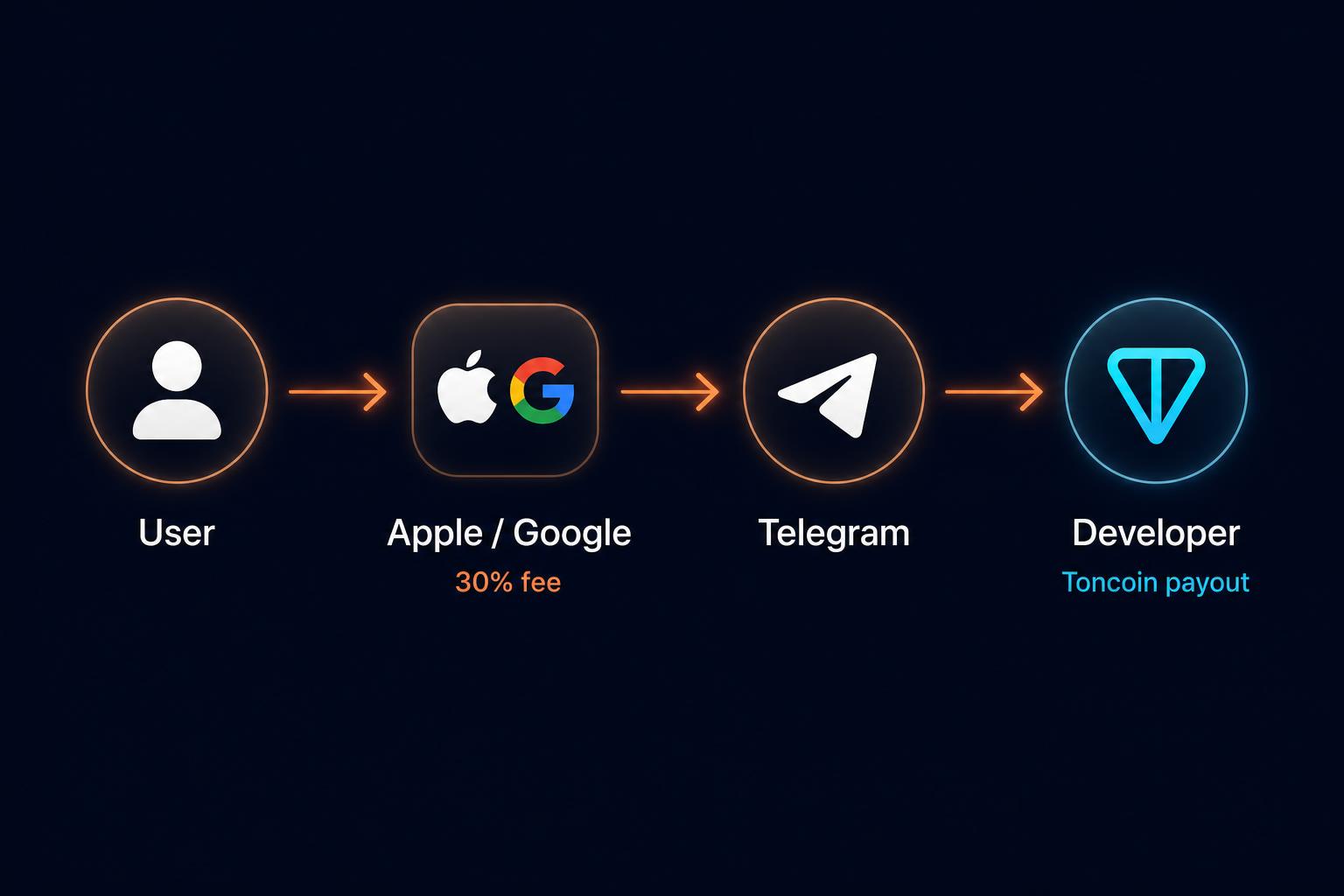
The introduction of Telegram Stars marks a pivotal moment for bot monetization, particularly for those offering digital goods and services. Telegram Stars is an in-app currency that users can purchase through standard Apple and Google in-app purchase systems. They can then spend these Stars to buy digital items directly from bots, such as e-books, game items, art, or "pro" features. This system dramatically reduces payment friction, as users can complete a purchase with a single tap without ever leaving the Telegram app or entering credit card details.
For developers, this model opens up the vast market of microtransactions. Bots for gaming can sell power-ups or cosmetic items. Educational bots can sell individual courses or content packs. Creator bots can accept tips or sell exclusive digital art. The process is designed for simplicity. Developers whose bots receive Stars can then withdraw their earnings in the form of Toncoin (TON), the native cryptocurrency of The Open Network blockchain, which can be exchanged for fiat currency.
However, operators must be aware of the commercial terms. When a user buys Stars, Apple or Google retains its standard 30% commission on the sale. Telegram then subsidizes ads purchased with Stars, creating a circular economy. When a developer withdraws their Stars as Toncoin, they receive their share of the revenue. This structure is a response to the strict rules imposed by mobile platforms on digital goods sales, and while the 30% fee is significant, the benefit lies in accessing a frictionless payment method trusted by millions of users. It removes the complex requirement of setting up and maintaining a separate payment processing infrastructure.
Advertising and Audience-Based Monetization
When a Telegram bot or its associated channel attracts a large and engaged audience, that attention becomes a monetizable asset. The most direct approach is advertising. This can be executed in several ways, each with its own strategic considerations. The key is to integrate promotional content in a way that respects the user experience and maintains the trust you have built with your audience. Irrelevant or intrusive ads can quickly lead to users blocking your bot.
One method is selling direct sponsorships. In this arrangement, a partner company pays you to feature a message, button, or link within your bot's interface or in broadcast messages to your channel. This works best when the sponsor is highly relevant to your audience. For example, a crypto news bot could partner with a new crypto exchange. A second method is affiliate marketing, where you recommend a product or service and earn a commission on sales generated through your unique referral link. This is a performance-based model that rewards you for driving real business to your partners.
Finally, for very large public channels, operators can use the official Telegram Ad Platform. This system allows Telegram to display unobtrusive, sponsored messages in your channel, and you receive a revenue share. This model offers a more passive income stream and ensures that the ads shown comply with Telegram's quality standards. Regardless of the method, transparency is paramount. Users are more receptive to advertising when it is clearly identified as such and when the promoted products or services are genuinely aligned with their interests.
Advanced Models: Web3 and Tokenization
A more complex but potentially powerful monetization strategy lies in the integration of Web3 technologies, particularly through the TON blockchain. Rather than treating users as customers, this model transforms them into stakeholders within a micro-economy powered by your bot. This is often accomplished by launching a proprietary token that is distributed to users as a reward for their engagement, such as participating in games, contributing content, or completing specific tasks. This is the foundation of the "Play-to-Earn" phenomenon.
These tokens can possess real utility within your bot's ecosystem. They might be required to access premium features, vote on governance decisions, or be traded on decentralized exchanges for other cryptocurrencies like Toncoin. This model does more than just generate revenue; it fosters a deeply loyal community. When users hold a token tied to your bot, they are financially and emotionally invested in its success. Their incentives are aligned with yours, as the growth of the bot's user base and utility can increase the value of the token they hold.
Implementing a token-based economy is not a simple undertaking. It requires a deep understanding of tokenomics, blockchain development, and regulatory considerations. The token must have a clear purpose and a sustainable economic model to prevent inflationary pressure or loss of value. However, for ambitious projects aiming to build a self-sustaining digital nation on Telegram, tokenization offers a sophisticated framework for capturing value and cultivating a dedicated community of advocates.
Strategic Implementation: From Model to Market
Choosing a revenue model is a critical decision, but execution determines its success. Operational excellence is what separates thriving bot businesses from failed projects. At the core of this is a relentless focus on the user experience. Payments, in particular, must be as frictionless as possible. Integrating Telegram’s native Payments 2.0 API allows users to pay with credit cards, Apple Pay, or Google Pay in a few taps, directly within the chat interface. Every additional step or redirect in the payment process is a point where you will lose potential customers.
Value delivery must be immediate. When a user pays for a subscription or a digital good, the promised feature or content must be provisioned instantly. This requires solid backend automation, using webhooks to listen for successful payment events and automatically update the user's permissions or deliver their purchase. This instant gratification builds trust and validates the user's decision to pay. Equally important is transparency. In an environment like Telegram, where users are wary of scams, you must be explicit about what they are paying for, how much it costs, and how they can manage their subscription or seek support. Clear "Manage Subscription" and "Contact Support" buttons are not optional; they are essential components of a trustworthy commercial operation.
Effective management extends to communication and analytics. Optimizing your revenue requires understanding your users’ behavior. As a content management and analytics platform for Telegram, we at TeleSuite emphasize the importance of data in decision-making. By analyzing user activity patterns, you can determine the best time to announce a new premium feature or send a promotional message. By tracking conversion funnels, you can identify where users drop off in the payment process and make targeted improvements. A successful Telegram bot business is not just built on a clever idea; it is run with operational discipline.
Frequently Asked Questions
Can I accept credit card payments directly in my Telegram bot?
Yes. Telegram's Payments 2.0 API integrates with multiple payment providers like Stripe. This enables users to complete purchases using credit cards, Google Pay, or Apple Pay inside the app. For digital goods and services, however, Telegram now requires using Telegram Stars to comply with app store policies.
How much does Telegram take from my bot's revenue?
When using a direct payment provider like Stripe, Telegram takes no commission; you only pay the standard processing fees of the provider. For sales via Telegram Stars, Apple or Google take a 30% commission from the user's purchase of Stars. Developers can then withdraw their earned Stars as Toncoin.
What is the most profitable niche for Telegram bots today?
FinTech and cryptocurrency trading bots historically generate substantial revenue due to the high value of transactions they facilitate. However, the emerging "SocialFi" and gaming category, exemplified by phenomena like Notcoin, is showing immense growth by using Telegram Stars for microtransactions and engaging millions of users.
Is it legal to run an ad-based bot on Telegram?
Yes, it is permitted as long as your advertising practices comply with Telegram's Terms of Service and are not deceptive. Utilizing the official Telegram Ad Platform is the most compliant method for large channels. Direct sponsorships and relevant affiliate marketing are also standard and accepted industry practices.
How do I handle customer support for paying users?
Providing dedicated support for paying customers is crucial for retention. The best practice is to offer a clear, easily accessible support channel directly within your bot, such as a command like /support that connects them to a human agent (or a separate support bot), a dedicated support email, or a private Telegram group for premium users.
What metrics should I track to measure my bot's financial success?
Key financial metrics include Monthly Recurring Revenue (MRR) and Annual Recurring Revenue (ARR) for subscription models, Average Revenue Per User (ARPU), Customer Lifetime Value (CLV), and Churn Rate. For transactional models, track Total Transaction Volume and your commission revenue. It is also vital to monitor the conversion rate from free to paid users.
Next step
The variety of Telegram bot revenue models now available allows nearly any valuable service to become a profitable business. The critical task is to map the right model to your users' intent and your bot's core function. Begin with a simple, clear value proposition-perhaps a single subscription tier or a well-defined transactional fee-and refine your strategy based on the data your users provide. To dive deeper into building and managing a successful bot-based enterprise, we encourage you to explore the strategies outlined in our complete guide to Telegram bot revenue models.