What Is the Semantic Shelf? The AI Category That Decides If You're Recommended

- semantic-shelf
- ai-visibility
- ai-search-optimization
- agentic-ecommerce
- generative-engine-optimization
A Semantic Shelf is the category, audience, use case, and comparison group that an AI system assigns to your product. It decides which alternatives enter your candidate set and which buyer prompts your product can even be considered for. Two variables set it: classification accuracy and evidence strength. Both are measurable, both are fixable, and neither is controlled by schema.
The term Semantic Shelf comes from Nitin Kumar in his essay Beyond the Schema, and it is now the frame I use with every merchant asking why ChatGPT does not recommend their catalog. It sits under both SEO and AEO. If your product is on the wrong shelf, no amount of content or schema will move it. This post is the short glossary version. For the full playbook, see the pillar: Beyond Schema: Why AI Doesn't Recommend Your Products.
What is a Semantic Shelf?
A Semantic Shelf is the meaning-layer position an AI model assigns to a product. Think of it as the category the model would place your product in if you asked it to file everything it has ever read about you. That position controls:
- The alternatives that appear in your candidate set.
- The buyer prompts your product is eligible to answer.
- The comparison language that gets pulled around your product in an answer.
A trench coat could be filed under luxury outerwear, sustainable fashion, commuter rainwear, travel clothing, or affordable workwear. Each shelf creates a different competitive set and a different buyer prompt.
How is a Semantic Shelf different from a product category?
A product category is what you write in your CMS. A Semantic Shelf is what the model actually infers from every signal it has seen: your page copy, retailer copy, review sentiment, editorial mentions, creator posts, feeds, and past user prompts. The two often disagree. When they disagree, the model uses its inferred shelf, not your declared category. This is why re-tagging products inside your Shopify admin rarely moves AI recommendations.
The two variables that set your shelf
- Classification accuracy. Does AI understand what the product is, who it serves, and when it should be considered? Weak classification is usually caused by ambiguous product names, missing use case in the first sentence, and inconsistent retailer copy.
- Evidence strength. Does credible public information support the claims required for a shortlist decision? Evidence strength depends on how much text near the buyer's meaning corroborates your product, not on raw mention volume. Lian Pham's pre-registered study of 1,679 products found that raw mention volume showed a slightly negative correlation with recommendation, while text density near the query correlated positively.
The 2x2 that explains most AI visibility outcomes
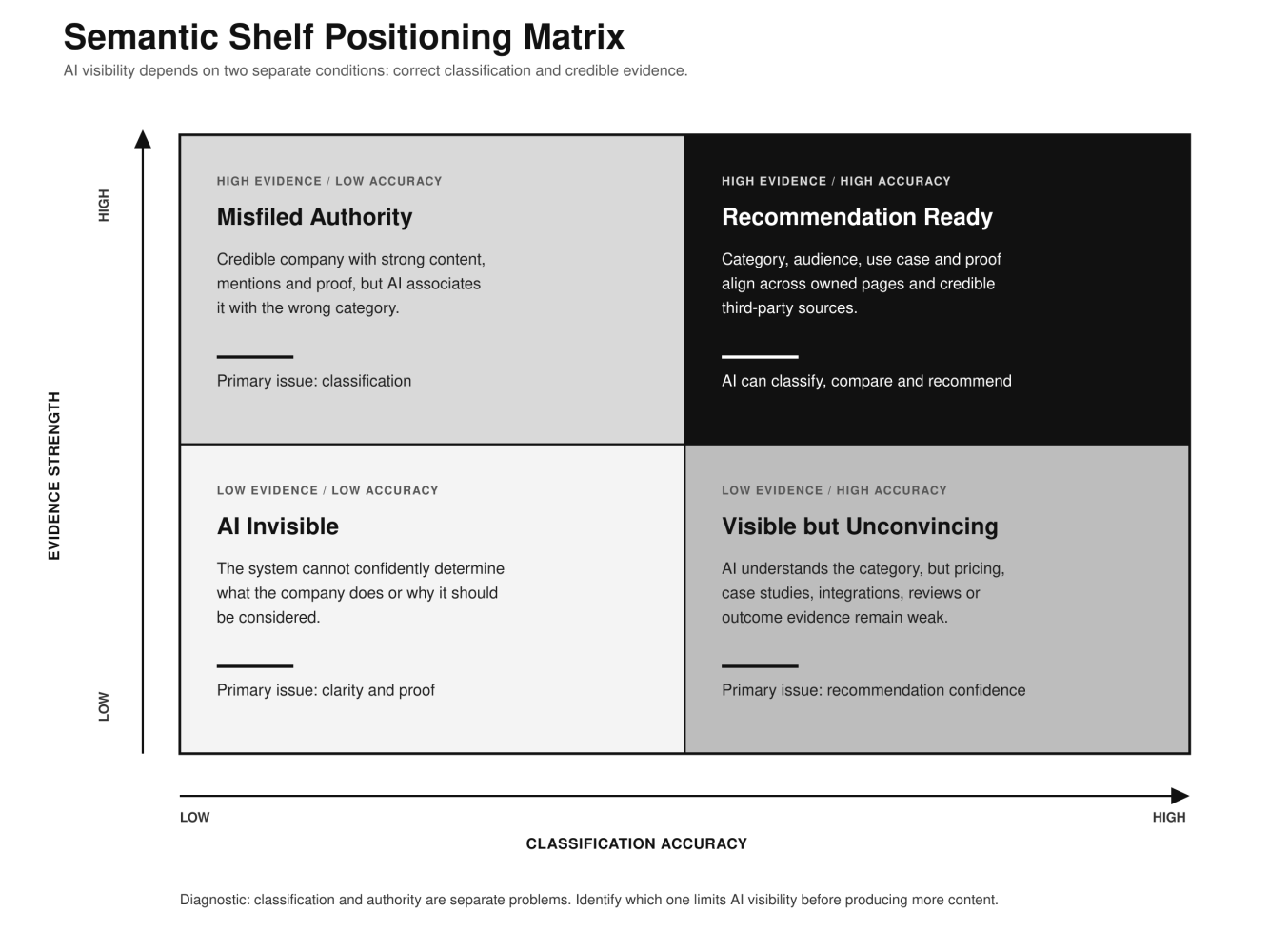
| Classification | Weak evidence | Strong evidence |
|---|---|---|
| Correct shelf | Understood, rarely shortlisted. | Recommended. Target quadrant. |
| Wrong shelf | Invisible in AI answers. | Loud in the wrong buyer prompt. |
How do I test the Semantic Shelf my product currently occupies?
Three-step test I use with merchants:
- Ask three models the shelf question. Prompt ChatGPT, Gemini, and Perplexity: "How would you categorize [Product Name] by [Brand]? Who is it for and when would you recommend it?" Capture the answers verbatim.
- Compare against your intended shelf. Write down the category, audience, and use case you actually sell to. Line up the model answers next to it. Every drift is a classification gap.
- Check candidate-set inclusion. Ask each model your top buyer prompt. If your product is not in the candidate set of 5 to 10 items, the shelf is either wrong or the evidence is too thin. TeleScope automates this test at catalog scale.
What moves a product to a better Semantic Shelf?
In order of impact:
- Rewrite the first visible sentence on every priority product page to state product type, audience, use case, and one meaningful constraint.
- Align the same sentence across retailer and marketplace listings so the model sees one product, not three.
- Solicit third-party evidence that answers the buyer's real questions (fit, durability, climate suitability, comparison), not generic brand praise.
- Sweep the sentiment environment quarterly. Recommended products live in less negative surrounding text (24.8% negative versus 29.0% for unpicked products).
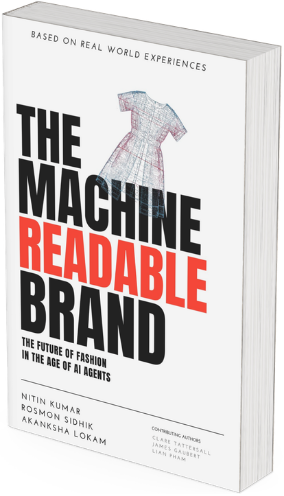
The Machine-Readable Brand
The full playbook on the Semantic Shelf and AI product recommendation, by Rosmon Sidhik and Akanksha Lokam with Nitin Kumar.
Get the book on Amazon →Map your Semantic Shelf in 60 seconds
TeleScope shows you the shelf ChatGPT, Gemini, and Perplexity have filed your products under, and the exact evidence gap to close.
Read the research: Lian Pham's pre-registered study on Zenodo.
Go deeper: The Machine-Readable Brand by Rosmon Sidhik and Akanksha Lokam with Nitin Kumar.
FAQ
Is Semantic Shelf the same as generative engine optimization?
No. Generative engine optimization is the wider discipline of ranking in AI answers. Semantic Shelf is one specific mechanism inside it: the category position a model assigns to a product. You cannot do GEO for e-commerce without fixing your shelf first.
Does schema move my Semantic Shelf?
Schema helps the model extract facts about your product. It does not move the shelf. The shelf is set by natural-language signals: your product copy, retailer copy, reviews, editorial coverage, and creator posts.
Can I sit on more than one Semantic Shelf?
Yes, and most successful products do. A waterproof commuter trench coat can also sit on sustainable fashion and business travel shelves. The rule is that each shelf needs its own supporting evidence. You cannot claim three shelves without publishing and corroborating three distinct buyer prompts worth of material.
How often should I re-test my Semantic Shelf?
Quarterly at minimum. Model refresh cycles, new competitor launches, and shifts in review sentiment can all move your shelf without any change on your side.
How does Brand-to-Product Translation Loss relate to the shelf?
Brand-to-Product Translation Loss measures how much of your organization-level recognition fails to become product-level understanding. A high Translation Loss almost always means the product is on the wrong shelf or on no shelf at all.