How to Get Your Products Recommended by ChatGPT (2026 Playbook)
- chatgpt-shopping
- ai-search-optimization
- semantic-shelf
- ai-visibility
- agentic-ecommerce
Getting recommended by ChatGPT is not a schema exercise, it is a recognition and evidence exercise. The models that shortlist your product need to know the product exists, file it on the right Semantic Shelf, and find enough text near the buyer's query to prefer it over 40 alternatives. Here are 9 concrete moves derived from Lian Pham's pre-registered study of 1,679 products.
Every merchant I audit asks the same question: how do I get ChatGPT to recommend my products? The honest answer is that this is a young discipline and most public advice is wrong. The best signal I have found comes from Lian Pham's TeleSuite study covering 46 buyer queries, 1,679 products, and 99,436 scored evidence snippets, and from Nitin Kumar's two essays translating the research into a merchant playbook. The 9 moves below are drawn directly from that work. Pair them with the pillar post: Beyond Schema: Why AI Doesn't Recommend Your Products.
1. Rewrite your product's first visible sentence for portable identity
The single highest-return change I have seen. When a model surfaces a fragment of your page in an answer, it uses the first visible sentence to reconstruct the product identity. If your first sentence is a conversion hook ("Transit 02 is here"), the model has nothing to work with. Rewrite it to state: product type, target audience, primary use case, one meaningful constraint. "A waterproof commuter trench coat for professional women, sized for layering, under $300" beats "The Essential Edit" every single time in a ChatGPT answer.
2. Run 40 to 80 buyer-intent prompts across three models
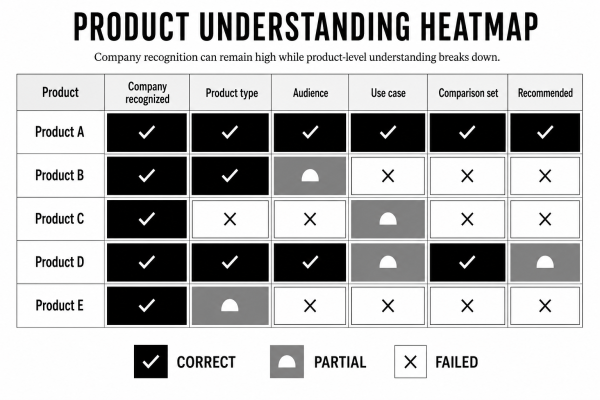
Recognition is measurable. Pick your 3 to 5 priority products. Write the 40 to 80 buyer-intent prompts a real shopper would type. Run them across ChatGPT, Gemini, and Perplexity. For each prompt, record four numbers: was the product recognized, was it classified correctly, was it in the shortlist, was it recommended. That is your baseline. Lian's study showed familiarity correlated with recommendation at r=0.176 while evidence density correlated at r=0.077, which means recognition is a gate and everything downstream depends on clearing it.
3. Audit evidence density near the buyer's meaning
The study's matched-pair analysis is the number I quote most often: across 507 pairs of products with similar semantic proximity, the recommended product had 1.6 more supporting text snippets on average (p=0.002). Recommended products had more supporting text in 53.8% of pairs, versus 42.8% for the unpicked product. Translation: for each priority prompt, count how many independent public text snippets discuss your product in the exact language of the prompt. If a competitor has 2 more, you have a specific, closable gap.
4. Sweep the sentiment environment
An exploratory finding in the same study is quietly the most actionable. Recommended products sat in text environments that were 24.8% negative. Unpicked products sat in 29.0% negative material. A quarterly sentiment sweep of reviews, press, and Reddit is worth more than most link-building campaigns. Reply to unresolved complaints, refresh out-of-date press summaries, and address specific product-question complaints (fit, durability, sizing) with public answers.
5. Align retailer copy to your own product sentence
If your Shopify page says "waterproof commuter trench coat" and Nordstrom says "everyday classic outerwear" and Zalando says "seasonal outerwear," the model reads three products, not one. Send the exact opening sentence to every retailer partner and ask them to lead their description with it. This is the least glamorous move on the list and it produces the fastest classification lift I have measured.
6. Corroborate through reviewers who answer buyer questions
Reviews that say "great brand" are close to worthless for AI recommendation. Reviews that say "this coat handled two hours of London rain and still packed flat into a carry-on" are the evidence the model uses to decide. Encourage reviewers to answer the specific buyer questions in your priority prompts. On Trustpilot, Google Reviews, and Reddit, seed the specific comparison language you want the model to inherit.
7. Fix feed hygiene, but only to the extent it unblocks the other 8
OpenAI's product-feed specifications help ChatGPT index and present your catalog accurately. Bad feeds cause the model to see stale prices, wrong availability, and missing images. Good feeds do not, on their own, cause recommendations. Ship a clean feed so you are eligible, then move on. Stop treating feed completeness as your AI visibility strategy.
8. Test classification directly by asking the models
The simplest test I know. Ask ChatGPT, Gemini, and Perplexity: "How would you categorize [Product Name] by [Brand]? Who is it for, and when would you recommend it?" Compare the three answers to your intended positioning. Every drift is a Semantic Shelf gap. This test takes 5 minutes per product and it usually explains 80% of a merchant's recommendation problem before any other work.
9. Own the shelf publicly, not privately
Merchants often win the classification battle inside their own site and lose it outside. The shelf is set by public evidence. Publish one strong external answer per priority prompt: a comparison post on your blog, a Reddit answer with your genuine opinion, an editorial guest post, or a YouTube explainer. Repeat the exact category language across all four. Over 90 days, this reshapes the shelf the model files you under. And it is what The Machine-Readable Brand by Rosmon Sidhik and Akanksha Lokam with Nitin Kumar develops at book length.
Skip the manual audit.
TeleScope runs moves 2, 3, 4, and 8 automatically across your catalog and shows you the exact evidence gap for each priority product.
How to sequence the 9 moves
| Week | Move | Why |
|---|---|---|
| Week 1 | Moves 2 and 8 | Get a baseline before you change anything. You cannot manage what you have not measured. |
| Week 2 | Moves 1 and 5 | Rewrite the identity, align retailers. These are pure classification fixes and they move numbers fastest. |
| Weeks 3 to 4 | Moves 3, 4, and 6 | Close the evidence gap and clean the sentiment environment. |
| Week 5 | Move 7 | Ship the feed cleanup so you are eligible for enhanced results. |
| Weeks 6 to 12 | Move 9 | Publish the public shelf-shaping content. Slow burn, biggest compounding return. |
| Week 12 | Rerun move 2 | Compare the recommendation rate to your baseline. Fold learnings back into the next quarter. |
What NOT to do
- Do not chase raw brand mention volume. It showed a slightly negative correlation with recommendation in the TeleSuite study.
- Do not publish more content against a wrong Semantic Shelf. It multiplies the wrong signal.
- Do not use a single AI visibility score as your KPI. It hides recognition, classification, and evidence failures in one blended number.
- Do not stop at schema. Schema handles layers 1 and 3 of comprehension; layers 2 (identity) and 4 (recommendation) are where recommendation actually lives.
FAQ
How long before I see ChatGPT recommendations change?
Classification changes (moves 1, 5, 8) show up in 2 to 6 weeks as models refresh. Evidence and sentiment changes (moves 3, 4, 6, 9) compound over 60 to 120 days. Do not judge results before the 90-day mark.
Do I need Bing or Google indexing to be recommended by ChatGPT?
Not entirely. ChatGPT uses a mix of learned model knowledge and live browsing. Recognition inside the model matters even when live browsing is off. Both channels reward the same evidence discipline.
Can Perplexity and Gemini be optimized the same way?
Yes with small tuning. Perplexity leans more on live citations, so evidence density near the buyer's query matters even more. Gemini blends learned knowledge and Shopping Graph data, so feed hygiene has slightly higher weight there. The 9 moves apply to all three.
How is this different from GEO or AEO?
Generative engine optimization and answer engine optimization are the wider disciplines. This 9-move playbook is the product-recommendation slice of GEO, tuned for merchants. If you sell physical goods and want to appear in ChatGPT shopping answers, this is the layer to work on before general GEO tactics.
How do I know if my product is on the wrong Semantic Shelf?
Run move 8 (ask the models to categorize your product). If two out of three models return a category that is not the one you sell to, you are on the wrong shelf. See the glossary post: What Is the Semantic Shelf?
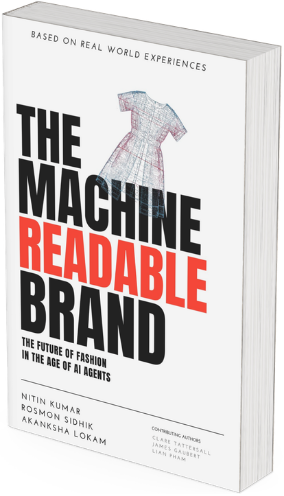
The Machine-Readable Brand
The full playbook on the Semantic Shelf and AI product recommendation, by Rosmon Sidhik and Akanksha Lokam with Nitin Kumar.
Get the book on Amazon →Ready to run the 9-move audit?
TeleScope handles the measurement moves (2, 3, 4, 8) across your catalog and gives you the exact evidence gap per priority product.
Read the research: Lian Pham's pre-registered study on Zenodo.
Go deeper: The Machine-Readable Brand by Rosmon Sidhik and Akanksha Lokam with Nitin Kumar.